Teralba to Present Dimpleflo Anti-Fouling Heat Transfer Technology at the Heat Exchanger Fouling & Cleaning Conference
Fouling is one of the most persistent challenges in industrial heat transfer.
It reduces thermal performance, increases pressure drop, shortens operating campaigns, and forces cleaning shutdowns. For many plants, fouling has become something that is accepted, budgeted for, and managed after the damage has already started.
At Teralba, we believe that mindset needs to change.
That is why Teralba Industries is pleased to be presenting Dimpleflo anti-fouling heat transfer technology at the Heat Exchanger Fouling & Cleaning Conference in Athens, Greece, from 14–18 June 2026.
Rethinking the tube wall
In every heat exchanger, the tube wall is where the critical activity occurs. It is where heat transfers, where the thermal boundary layer forms, and where fouling deposits begin to attach.
Traditional enhanced tubes often focus on improving heat transfer. Dimpleflo takes this further by asking a more important question:
Can the tube surface be designed to improve heat transfer while also working against fouling?
What makes Dimpleflo different
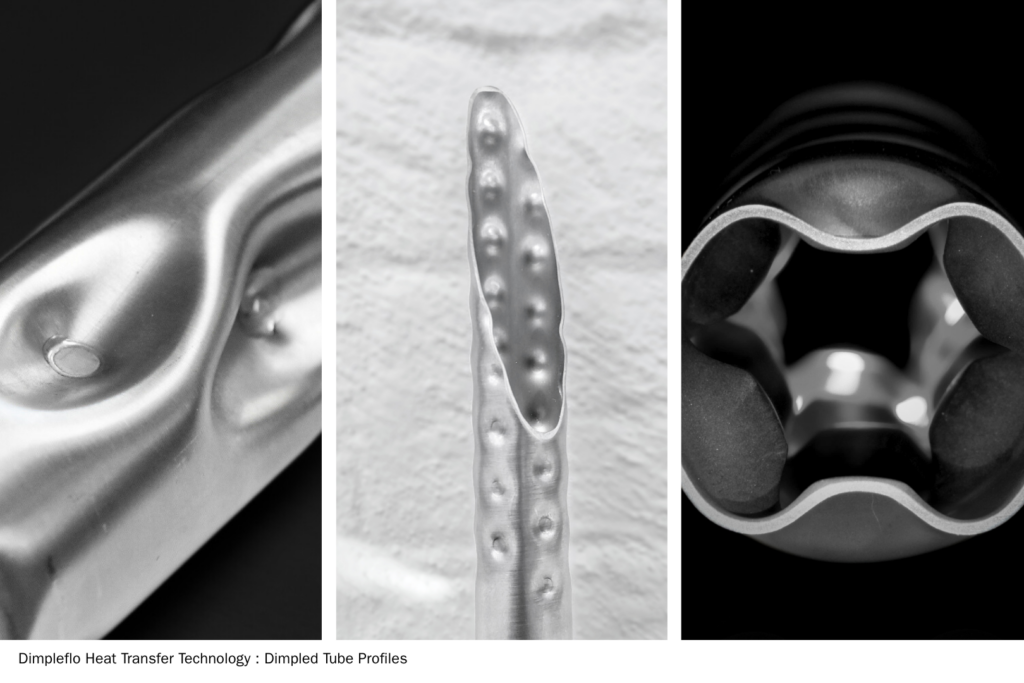
Dimpleflo uses precision-formed tube geometry to influence fluid behaviour inside the tube. Rather than simply creating more turbulence, the geometry is designed to generate useful near-wall flow activity where fouling begins.
Testing has shown that Dimpleflo L5 geometry can create local eddies and vortex activity near the tube wall. This helps renew the wall region, disrupt the thermal boundary layer, and make it harder for deposits to stabilise.
This means Dimpleflo is more than an enhanced heat-transfer tube. It is a heat-transfer surface designed to actively work against fouling.
Built for real industrial conditions
Dimpleflo is not just a laboratory concept. It is a manufacturable technology developed by Teralba over more than 30 years.
The formed tube geometry can be produced in practical tube and pipe configurations using materials suited to real industrial service, including stainless steel, duplex stainless steel, titanium, and high tensile steel.
That matters because fouling happens in demanding environments such as food processing, wastewater, oil and gas, chemical processing, mineral processing, and pulp and paper applications.
Dimpleflo has been developed for that real world.
A smarter way forward
The goal is not to claim that fouling can be eliminated from every heat exchanger. Industrial fouling is too complex for that.
The bigger opportunity is to design selected heat exchangers more intelligently from the start by choosing the right tube geometry, material, velocity range, and operating regime.
Dimpleflo represents a different way of thinking about heat transfer: a tube surface that does more than carry fluid and transfer heat.
It helps shape the flow where it matters most.
Teralba is proud to take this technology to the Heat Exchanger Fouling & Cleaning Conference and share the story behind a simple but powerful question:
What if the heat-transfer surface could help protect itself?